The 20% Down Payment Myth: What Texas Homebuyers Should Know Before Delaying Their Purchase
- Home Loan HQ

- Jun 15
- 8 min read
Updated: Jul 27

Many Texans believe they need a 20% down payment to buy a home. While putting more money down can offer certain advantages, it is far from the only path to homeownership.
Today, many buyers purchase homes using a combination of low-down-payment loan programs, down payment assistance, family gift funds, seller concessions, builder incentives, and other legitimate strategies that help reduce upfront costs.
Understanding your options could be the difference between buying sooner and waiting longer than necessary.
The Biggest Homebuying Myth in Texas
There is one belief that has delayed more home purchases than rising interest rates, housing inventory shortages, or market uncertainty: the idea that every buyer needs a 20% down payment.
For decades, prospective homeowners have heard the same advice: save 20% down before purchasing a home. While that strategy can make sense in certain situations, many Texas buyers are surprised to learn that it is far from the only path to homeownership.
Consider a buyer shopping for a $400,000 home. A 20% down payment equals $80,000 before accounting for closing costs, moving expenses, furnishings, or reserves. Faced with that number, many buyers assume they need years to prepare before purchasing.
Meanwhile, thousands of Texans are purchasing homes every year using financing programs and assistance options that may significantly reduce the amount of cash required upfront.
The purpose of this article is not to convince anyone to buy before they are ready. It is to help buyers make informed decisions based on facts rather than assumptions. Because in many cases, the difference between buying this year and waiting several more years is not income. It is understanding what options may be available.
What Do You Actually Need to Buy a Home?
One of the most common questions buyers ask is:
“How much money do I need to buy a home?”
The answer depends on several factors, including the loan program, property type, location, credit profile, available assistance programs, and whether additional funding sources are available.
Two buyers purchasing similarly priced homes may have dramatically different cash-to-close requirements. One buyer may need substantially more funds upfront, while another may qualify for programs or strategies that significantly reduce the amount required at closing.
That is why the conversation should never start with a fixed number.
It should start with a strategy.

Strategy #1: Choose the Right Loan Program
The mortgage itself is often the first opportunity to reduce upfront costs.
Many buyers assume all loan programs require the same down payment. They do not.
FHA Loans
FHA loans remain one of the most popular financing options for Texas homebuyers because they may allow eligible borrowers to purchase with a down payment as low as 3.5%.
For buyers who have steady income but haven’t accumulated a large down payment, FHA financing can provide an opportunity to become a homeowner sooner than expected. FHA loans may also allow family gift funds and can often be combined with certain assistance programs.
The value of FHA financing is not simply the lower down payment requirement. It is the flexibility it provides for buyers who are otherwise financially prepared for homeownership.
Conventional Low Down Payment Programs
Many people associate conventional financing with a 20% down payment. In reality, certain conventional loan programs may allow eligible borrowers to purchase with as little as 3% down.
Programs such as HomeReady and Home Possible were designed to expand access to homeownership while maintaining the benefits associated with conventional financing.
For buyers with strong credit profiles, these programs can provide a compelling alternative to government-backed loans.
VA Loans
For eligible veterans, active-duty service members, and qualifying surviving spouses, VA financing remains one of the most valuable mortgage benefits available.
VA loans may allow qualified borrowers to purchase without a required down payment while also eliminating monthly mortgage insurance requirements.
For military families, this benefit alone can dramatically change the timeline for homeownership.
USDA Loans
USDA loans are often misunderstood. Many buyers assume they only apply to remote rural areas. In reality, certain suburban and developing communities throughout Texas may qualify.
For eligible borrowers purchasing in qualifying areas, USDA financing may allow homeownership without a required down payment, making it one of the most powerful affordability tools available.
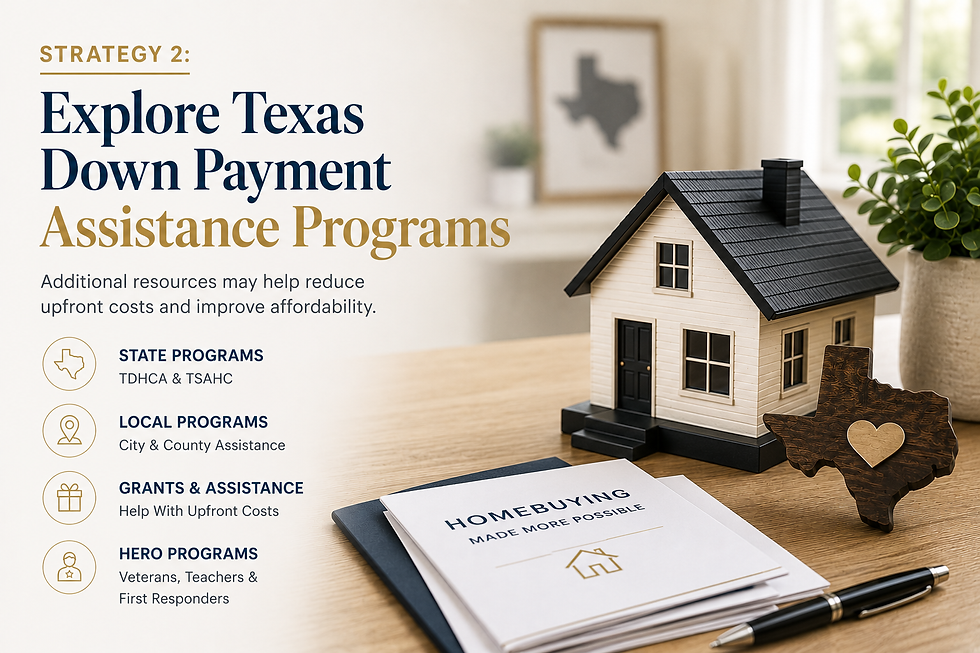
Strategy #2: Explore Texas Down Payment Assistance Programs
Once buyers understand their loan options, many discover that additional assistance may also be available.
Texas offers several statewide programs designed to help eligible homebuyers reduce upfront costs.
TDHCA Homebuyer Programs
The Texas Department of Housing and Community Affairs (TDHCA) offers programs designed to assist eligible homebuyers with down payment and closing cost assistance through participating lenders.
Programs such as My First Texas Home and My Choice Texas Home are intended to help qualified buyers bridge the gap between what they have saved and what they need to close.
TSAHC Home Sweet Texas
The Texas State Affordable Housing Corporation offers the Home Sweet Texas program, which may provide assistance to eligible buyers purchasing a primary residence.
For many Texans, these programs can help make homeownership more accessible while reducing the amount of cash needed upfront.
Homes for Texas Heroes
TSAHC also offers the Homes for Texas Heroes program for eligible professionals such as teachers, police officers, firefighters, EMS personnel, correctional officers, veterans, and certain healthcare workers.
These programs were created to support the individuals who help strengthen Texas communities every day.
Local Housing Assistance Programs
Many buyers focus only on statewide programs and overlook local opportunities.
Cities, counties, housing authorities, workforce housing initiatives, and nonprofit organizations may offer additional assistance depending on location and funding availability.
Because these programs change frequently, it is important to research opportunities within the city or county where you plan to purchase.

Do You Qualify for Down Payment Assistance?
This is where many buyers begin asking the right questions.
Programs may be available, but eligibility matters.
Income Limits
Many assistance programs are designed to help low-to-moderate income households. Eligibility is often based on Area Median Income (AMI), household size, and geographic location.
Income limits vary by county and program. Exceeding one program’s income limit does not necessarily mean you are ineligible for all programs.
First-Time Homebuyer Requirements
Many assistance programs are geared toward first-time homebuyers. However, the definition is often broader than people realize.
In many cases, a first-time buyer is someone who has not owned a primary residence within the previous three years.
Certain programs may also provide exceptions for veterans and buyers purchasing in designated target areas.
Property Requirements
Most assistance programs require the property to serve as the buyer’s primary residence. Additional requirements may include purchase price limits, occupancy requirements, geographic restrictions, and minimum property condition standards.
Credit and Debt-to-Income Requirements
Buyers are generally expected to demonstrate the ability to manage homeownership responsibly.
Programs often evaluate credit history, income stability, debt-to-income ratios, and overall financial readiness.
Meeting minimum guidelines does not guarantee approval, but strong preparation can improve eligibility.
How Buyers Can Improve Their Chances of Qualifying
The most successful buyers often prepare before they begin shopping.
Many assistance programs require a homebuyer education course. These courses cover budgeting, credit management, mortgage financing, and homeownership responsibilities.
Working with an approved lender is equally important. Participating lenders understand program guidelines and can help identify opportunities that align with a buyer’s situation.
Buyers should also gather documentation early, including pay stubs, W-2s, tax returns, bank statements, identification documents, and employment verification. Preparation often creates a smoother experience throughout the process.

Strategy #3: Look Beyond Personal Savings
One of the most misunderstood aspects of homeownership is where funds can come from.
Many buyers assume every dollar must come directly from their savings account.
That is not always the case.
Family Gift Funds
Depending on the loan program, eligible family members may be able to provide gift funds that can be used toward a down payment, closing costs, or reserves.
Parents and grandparents commonly help family members achieve homeownership through properly documented gift funds.
Employer Assistance Programs
Some employers offer housing-related benefits that may include relocation assistance, housing stipends, workforce housing initiatives, or employer-sponsored homebuyer assistance.
Many buyers never think to ask about these benefits, yet they can create meaningful savings.
Strategic Financial Planning
Tax refunds, employment bonuses, commission income, relocation reimbursements, and planned savings goals can all contribute to a stronger homeownership strategy.
Sometimes reducing upfront costs begins with better planning rather than finding a new program.

Strategy #4: Reduce Cash-to-Close Requirements
Reducing upfront costs isn’t always about finding more money.
Sometimes it’s about reducing the amount required at closing.
Seller Concessions
Seller concessions generally cannot be used toward the required down payment, but they may help cover closing costs, prepaid taxes, homeowners insurance, and interest rate buydowns.
In the right market conditions, seller concessions can significantly reduce a buyer’s cash-to-close.
Builder Incentives
New construction buyers may have access to builder incentives that include closing cost assistance, interest rate buydowns, design center credits, and preferred lender incentives.
These incentives can create substantial savings opportunities.
Lender Credits
Lender credits may help offset certain closing costs in exchange for a higher interest rate.
While not appropriate for every buyer, they can be useful when preserving cash is a higher priority than obtaining the lowest possible rate.
The Cost of Waiting
Many buyers spend years asking themselves:
“What if I buy too soon?”
Far fewer ask:
“What if waiting costs me more?”
The purpose of this article is not to encourage rushed decisions. However, it is important to understand that waiting also carries risk.
While a buyer saves for a larger down payment, several things may happen:
Home prices may increase.
Rent payments continue.
Mortgage rates may change.
Assistance programs may evolve.
Opportunities may be missed.
The right decision depends on your circumstances, but it should be based on facts rather than assumptions.
Real-World Example
Imagine Sarah wants to purchase a $350,000 home in Texas.
She believes she needs approximately $70,000 for a down payment plus additional funds for closing costs and reserves.
Because of that assumption, she plans to delay homeownership for several years.
After exploring her options, she learns she may qualify for:
A low-down-payment loan program
Down payment assistance
Family gift funds
Seller concessions to help offset closing costs
The exact outcome depends on eligibility and program guidelines. However, the most important thing that changed wasn’t Sarah’s income.
It was her understanding of the options available to her.
Many buyers are closer to homeownership than they realize.

Key Takeaways
The idea that every Texas buyer needs a 20% down payment is one of the most persistent myths in real estate.
Potential strategies that may help reduce upfront costs include:
FHA Loans
Conventional Low Down Payment Programs
VA Loans
USDA Loans
Texas Down Payment Assistance Programs
Local Housing Assistance Programs
Family Gift Funds
Employer Housing Benefits
Seller Concessions
Builder Incentives
Lender Credits
Strategic Financial Planning
The most effective solution is often not a single program, but a combination of strategies working together.

Before You Assume You Need 20% Down
The amount of money required to purchase a home depends on far more than a single number.
Your loan program, eligibility, location, financial profile, available assistance programs, and overall strategy all play a role in determining what may be possible.
Before assuming you need years to save for a home purchase, take the time to explore your approach. Because the best mortgage decisions start with understanding your options.
Schedule a discovery call, request a pre-qualification or pre-approval, compare loan programs, or access mortgage planning tools designed specifically for Texas homebuyers.

Jami Hightower | Loan Officer
Let’s explore the programs, assistance options, and strategies that may help reduce your upfront costs.
Important: This article is provided for educational purposes only and should not be considered financial advice, a loan approval, or a commitment to lend. Program availability, eligibility requirements, assistance amounts, rates, and guidelines are subject to change. All loans are subject to credit approval, income verification, property approval, and applicable lending requirements.